Dylan Ironside

Dylan Ironside · Founder & CEO, Super Hornet, Inc. · Coralville, Iowa

I’m building Super Hornet, the agent workspace for the AI you already use.

I’ve been building it since 2024, from the multi-provider runtime and server-owned runs to the iPhone and iPad app, its native browser, and the Chrome extension. I also built Hacker News for macOS, an open-source native Mac client, and the AI drafting workflow behind Braid Health’s radiology second opinions.

Super Hornet, Inc. is raising a pre-seed round. Investors: dylan@super-hornet.com

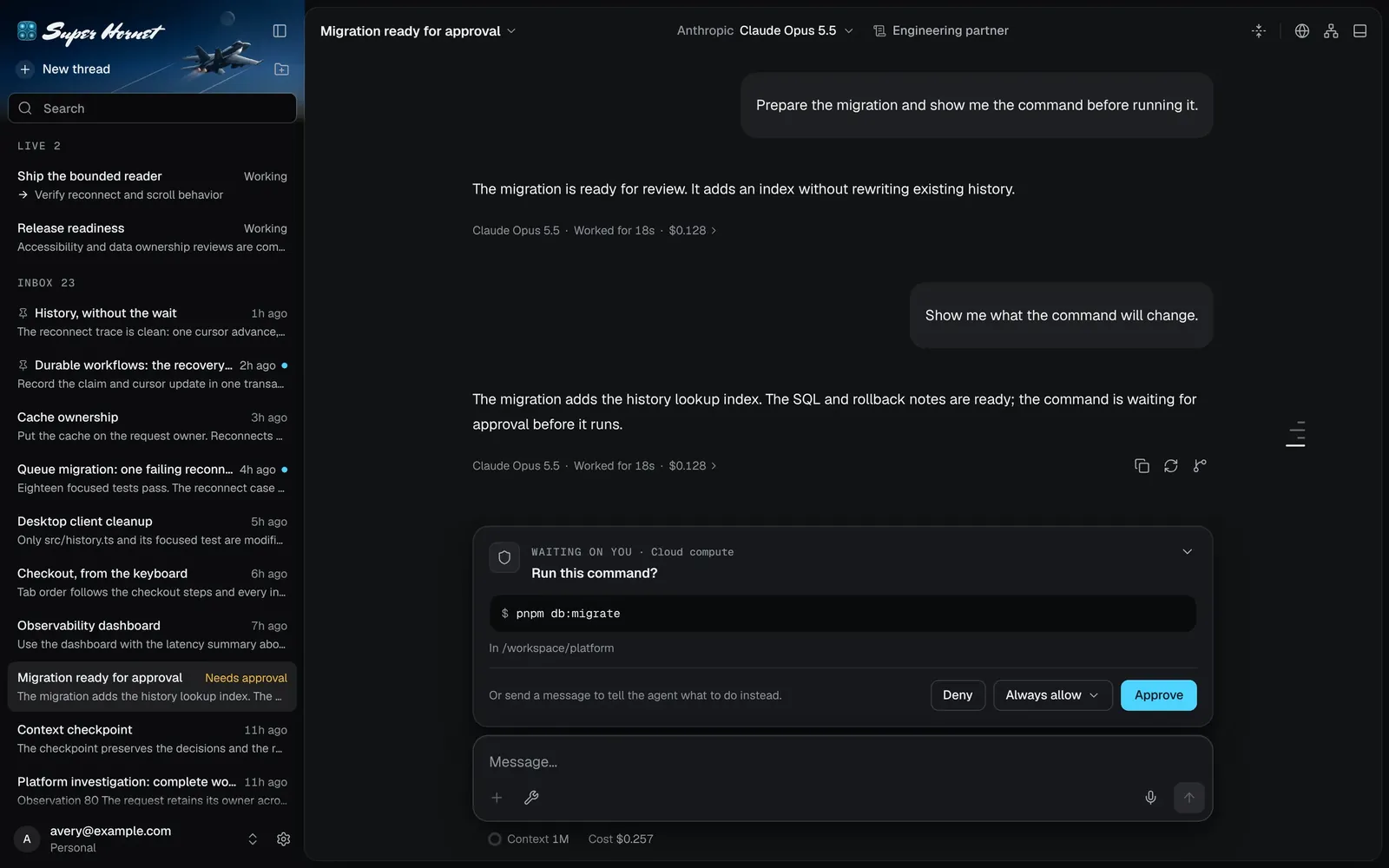
Super Hornet in a laptop-sized window. The sidebar lists two live runs and an inbox of threads. The open thread, on Claude Opus 5.5, has prepared a database migration and waits on an approval card that shows the exact command, pnpm db:migrate, with Deny, Always allow, and Approve.
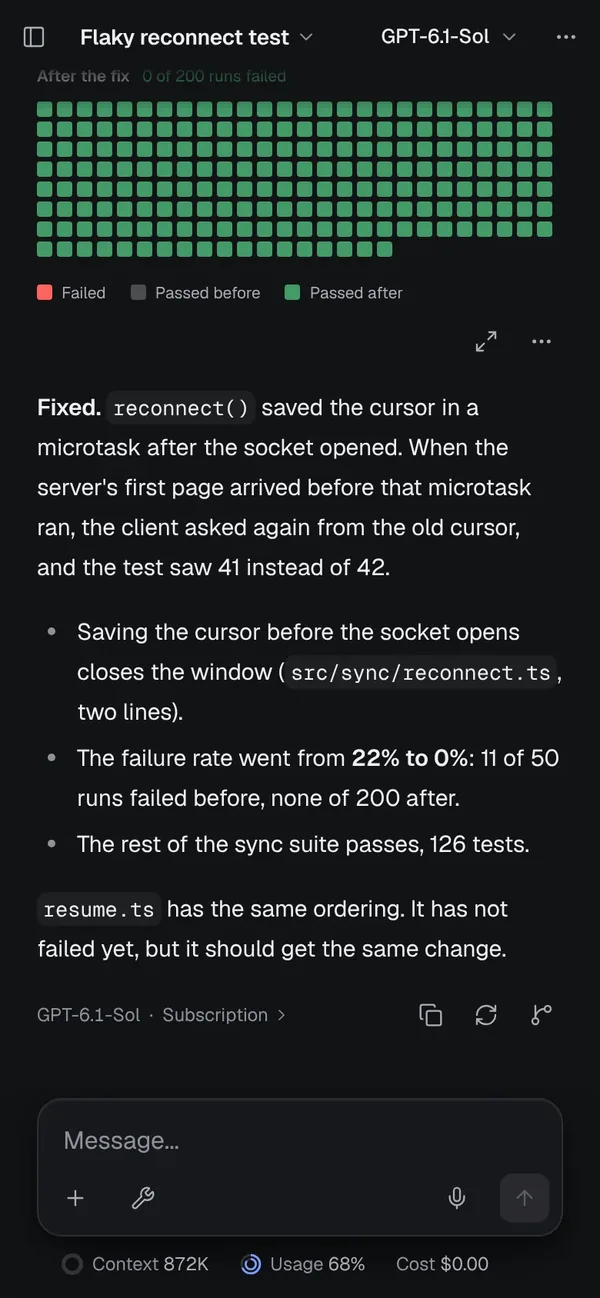
Super Hornet on an iPhone, in a thread on GPT-6.1-Sol: the agent explains how it fixed a flaky reconnect test, and its chart shows 0 of 200 runs failing after the fix, down from 11 of 50 before.
Super Hornet on desktop and iPhone: the real app with a demo account, captured October 2026.

01 · Founder & CEO · 2024 to present

Super Hornet

One workspace for the AI you already use: your ChatGPT, Claude, or Grok plan, or an OpenRouter key for 450+ models. Every conversation gets its own Linux computer, the agent works in your own browser, and runs belong to the server, so they keep going after you close the laptop.

  • One runtime, four providers

    ChatGPT through OpenAI’s Codex App Server, Claude through the Claude Agent SDK on your own Claude plan, Grok, and OpenRouter. Several accounts per provider, and a reply that hits a rate limit can continue on the next one.

  • Runs the server owns

    Close the laptop, lose Wi-Fi, or ship a deploy mid-run, and the work continues. Open the thread on any device and it is live from the first frame.

  • A computer per conversation

    Every conversation gets a Linux microVM that sleeps when idle and wakes with its files where it left them. Or pair your own Mac, Linux, or Windows machine with a one-time code. Each machine has its own approval mode.

  • The iPhone and iPad app

    A native app with its own browser that the agent works in, plus Live Activities, Siri, and Shortcuts.

  • Super Hornet for Chrome

    An extension that lets the agent work in your real Chrome tabs. When your device goes away, a private cloud browser carries the task.

  • Subagents and tools

    A thread can run a crew of subagents, each with its own model, tools, and machine. GitHub, Linear, Sentry, web search, memory, files, and image and video generation are built in.

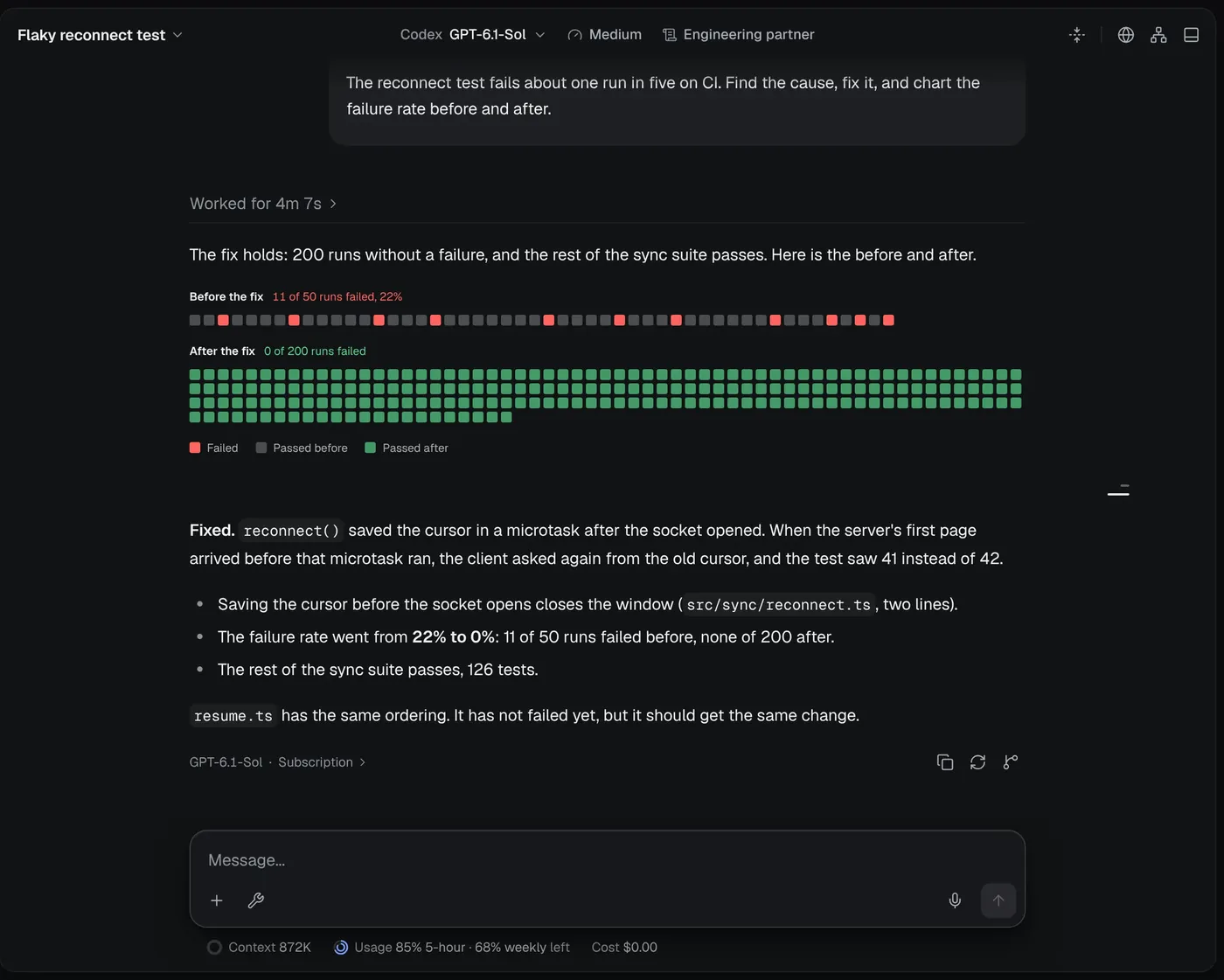
A Super Hornet thread on GPT-6.1-Sol through a ChatGPT plan. The agent worked for 4 minutes 7 seconds on a reconnect test that failed one run in five, charted 11 of 50 runs failing before the fix and 0 of 200 after, and explained the cause: a cursor saved in a microtask after the socket opened.
A finished run: the agent found a race in a reconnect test, fixed it, reran it 200 times, and charted the result. Demo account; the interface is real.

What’s hard about it

  1. Runs that outlive every client. Runs used to stream from inside the web process, so a deploy killed them. Now a run is a row in Postgres. A worker claims it, owns the model calls and the tool loop, appends every event in order, and hands off at safe boundaries during a deploy. A device that reopens a running thread starts from the worker’s own progress row, so it is live at once instead of replaying the turn.
  2. Four providers, one transcript. Each lane streams, reasons, and fails differently. Reasoning is replayed per provider, so a thread can change models mid-conversation. A reply that hits a rate limit settles its running tools, closes its open blocks, and continues on the next account without an error.
  3. An agent in a person’s own browser. Commands reach the person’s active device as claim-once rows over Postgres and server-sent events. Passwords, codes, and card numbers are redacted at the source before the model sees a page. Purchases and sends confirm the way the person chose, and a touch on the page interrupts the agent’s action.
  4. Containment. Every conversation runs in its own microVM. GitHub tokens are minted per operation, provider credentials are encrypted at rest with AES-256-GCM, and in Ask mode a command waits on an approval card that shows exactly what will run.

02 · Senior Technical Support Specialist · Oct 2022 to Oct 2026

Braid Health

Braid is an AI teleradiology startup, and half of my job there was engineering. I built the AI drafting workflow behind its $199 radiology second opinion and operated the replication system that moves X-rays from clinics to radiologists.

How a second opinion moves through the workflow
  1. InputPatientIntake form and prior reports
  2. AIAgentDrafts the case presentation and flags missing reports
  3. HumanRadiologistReads the images and writes the second opinion
  4. AIAgentDrafts a patient-friendly report from the radiologist’s findings
  5. ApprovalRadiologistApproves or edits before it reaches the patient
Second opinions
I built the workflow on Super Hornet. Drafting a case had meant hours of copying reports into a chatbot; the workflow did it in seconds, and operations leadership adopted it after a demo.
Guardrails
The prompts flag missing reports, stop on mismatched patient records, and keep report findings apart from what the patient reported. A radiologist approved every case, and patient data stayed in an isolated OpenAI workspace under a HIPAA BAA.
Replication
I operated Braid’s CouchDB replication on GKE and led outage response. A sync engine per organization moved X-rays from clinic hubs through a proxy that filters protected health information, across tens of thousands of per-user databases. I built the Datadog synthetic tests and alerts, and added a revision cap after runaway documents halted syncing.
Bucket+
I built a desktop app the support team used every day to bulk-download, dedupe, and sort patient imaging from Google Cloud Storage, in place of one-by-one downloads of unlabeled folders.
Support
I ran most of the daily Intercom queue, bug tracking in Linear, patient-record repair, and clinical onboarding, and built the Intercom workflows behind them.

03 · Open source · MIT · Feb 2026

Hacker News for macOS

I built a native Mac client for Hacker News in Swift and SwiftUI: stories, articles, and comment threads side by side, with built-in ad blocking and HN login. One GitHub Actions workflow builds, signs, and notarizes the app, packages the DMG, and publishes EdDSA-signed Sparkle updates. It reached the Hacker News front page as a Show HN.

04 · Experience

Experience and tools

  1. 2024 to presentFounder & CEO, Super Hornet, Inc.Delaware C-corp, incorporated October 16, 2026
  2. 2022 to 2026Senior Technical Support Specialist, Braid HealthAI workflows, internal tools, infrastructure operations, and support
  3. 2022Assistant Blockchain Developer, NFTNTWAX NFT backends for Trailer Park Boys and King Kong releases
  4. 2016 to 2021Support and salesTaxAct, Businessolver, Verizon (Salesforce), Best Buy, Ruffalo Noel Levitz (CRM)
  5. 2020 to 2021Kirkwood Community CollegeAssociate’s degree coursework
  6. 2018Coe CollegeLiberal arts coursework
Agent systems
Durable runs, multi-provider routing and failover, context compaction, sandboxed tools, browser agents, guardrail prompts
AI tooling
OpenRouter, Claude Agent SDK, Codex App Server, Vercel AI SDK, Claude Code, Codex, Cursor
Languages and platforms
TypeScript, Python, Swift, SQL, Next.js, React, PostgreSQL, CouchDB, SwiftUI, Chrome extensions
Infrastructure and quality
AWS, Kubernetes (GKE), Docker, E2B, Cloudflare, Depot CI, Vitest, Playwright, Sentry, Datadog

05 · Contact

Get in touch